Ingredients: Rain, Light, Sky, Reflection, & Camera
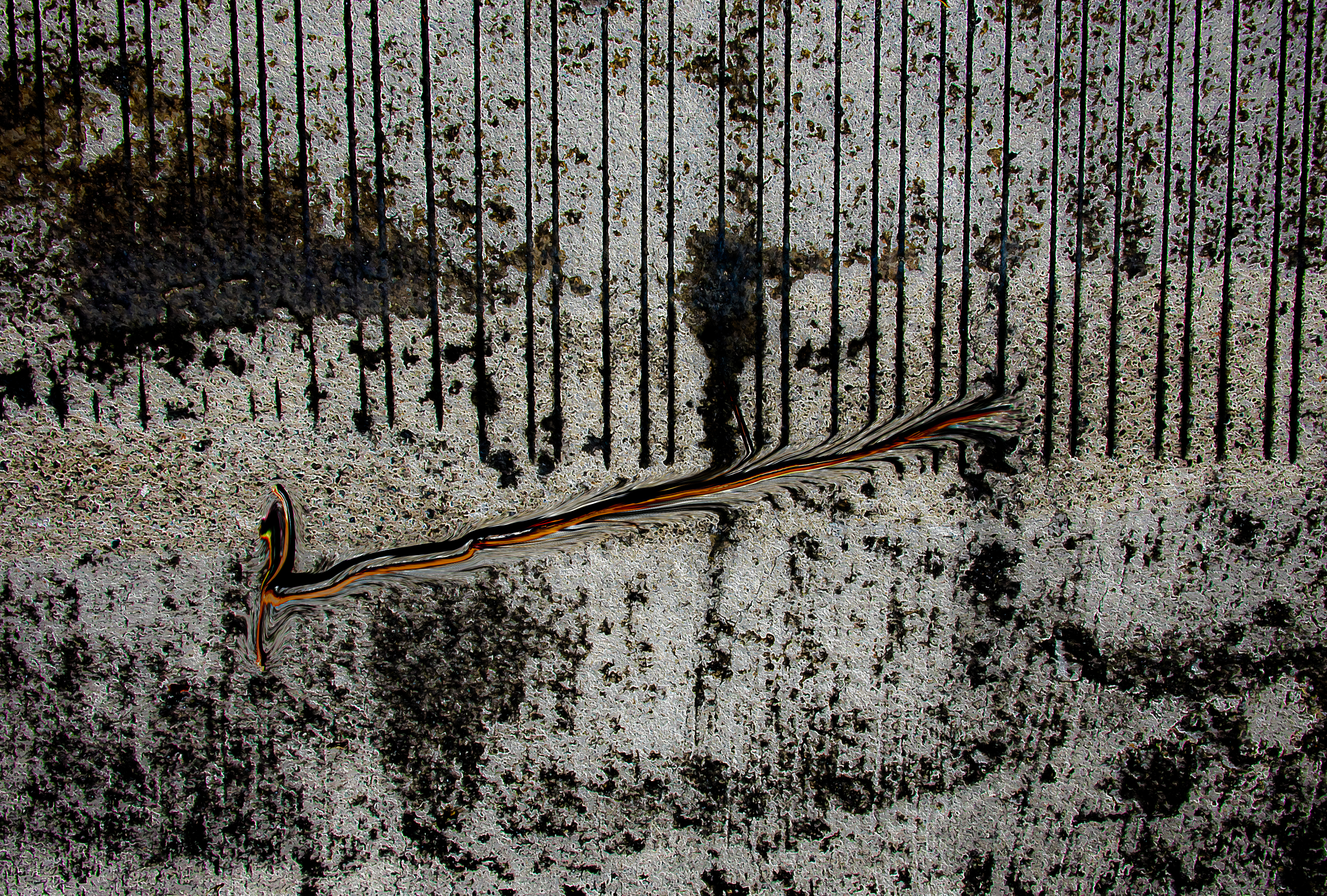
This image is a reflection. It is water during a rainstorm travelling through a chute. The image was taken at dusk, creating the dark blue sky. The moon is a streetlamp’s reflection, but it is also the reason the water has reds, yellows, and looks like flame and lava.
Climbing down the stairs, through the dead living room, out a missing front door.
Outside… where it is simple, yet intense, torn between silence and buzz.
Both show brightly. Both are masked.
Here, he grips nothing in his hands, squeezes them together as tight as they can clench, to feel the pressure, the strength of it, the life of it.
Above him, the sky is swathed in gray, mundane as if waiting for movement.
The sun is there, peeking through clouds.
If only he could see it move across the sky, he could reason with it.
Tell it about the way he walks.
If only she could move closer. He could reason with her.
Tell her about the way he is.
Jessie wonders if this is when time stands still. Is he missing how the world moves?
Does he misinterpret signs and speech patterns?
He looks keenly at the clouds, trying to see what is behind them.
The sun must have a meaning today beyond any other day past or coming.
As he looks down, the grass appears as a carpet of swirling chaos, fallen, but quickly vanishes.
He yearns for a powerful voice, but fears what he will do once he hears it, scared about answers that will drill a hole inside him.
Answers…
About loving someone that has a sickness.
Then, he must love sickness.
Doesn’t that stand to reason?
And he should be blamed for that, right?
Does he just accept that everything and everyone is cracked in some form or another? Or is it because he believes he himself is crazy, or at least on the spectrum of something never diagnosed, perhaps undiagnosable?
Just for a second, he thinks he sees a beam of light touch down amongst the grass.
He will tell her what he’s thinking. He knows she won’t understand. He doesn’t understand himself, this voice, her voice, all voices.
Maybe it is a strength and he’s weak. Maybe it is a weakness and he’s strong.
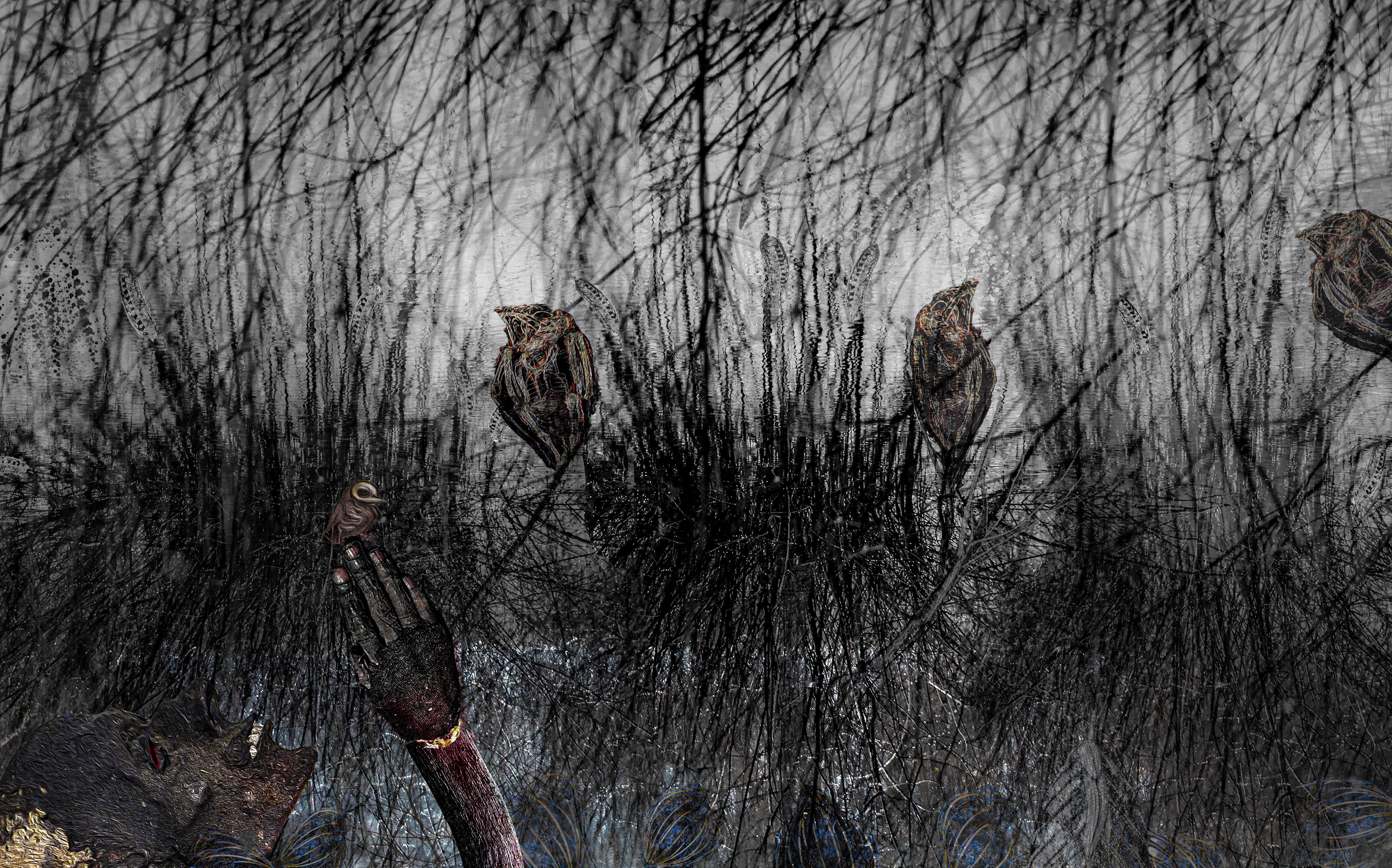
I was intrigued by a post by a fellow blogger. She writes that her father sees the forest anew every time he ventures out into it. What she wrote resonated with my feelings about the composition. I see this image not as death and horror, which it certainly can be viewed as such, but a recycling, an epiphany of sorts, a transfiguration of how and what we think about the nature that surrounds us. We learn its language for the first time every time we engage with it.
Transfigure was composed with a series of photographs, collaging and a bit of sketching. Click on it to enlarge.
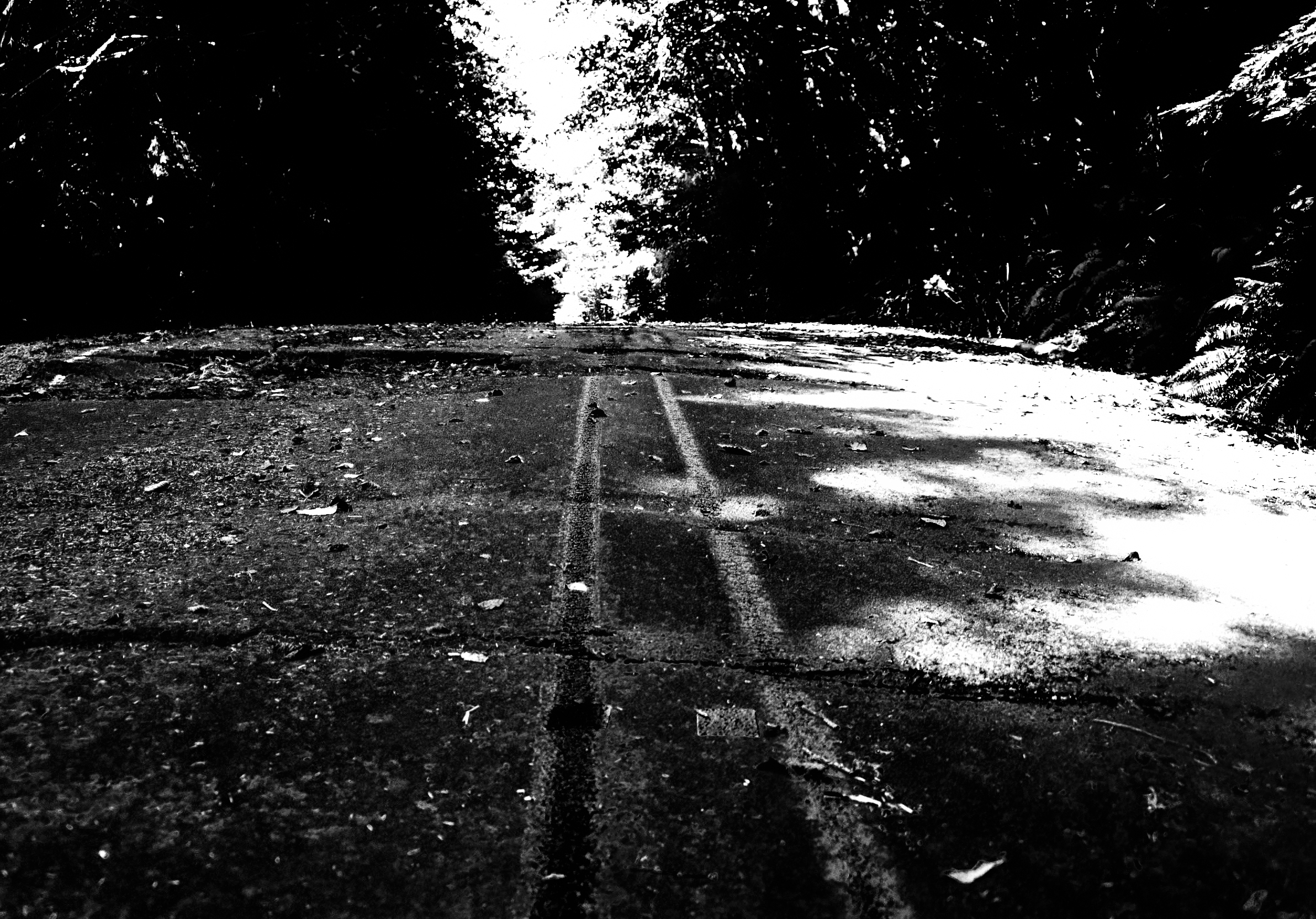
She walks along the old road, its surface broken, cracked, revealing the dirt underneath.
There are soft spots in the pavement scarred with plants, an occasional sapling, alive or dead.
Not an easy road to walk. She’s careful. Always.
Her eyes move along its lines, reading its rough syntax, wet on the edges, a dark, moist shadow frame.
She places her hands flat upon a remaining level surface.
Debris, pebbles, and a scree of thoughts stick to her.
She raises up her hands like opening a book.
How odd they look, their silhouette, alien.
She knows where the road goes, down to the lighthouse, where the coast trail flirts with beaches, towns, and a highway, winding in and out of a forest that meets the ocean.
She yells, for no particular reason, but for all the reasons in the world.
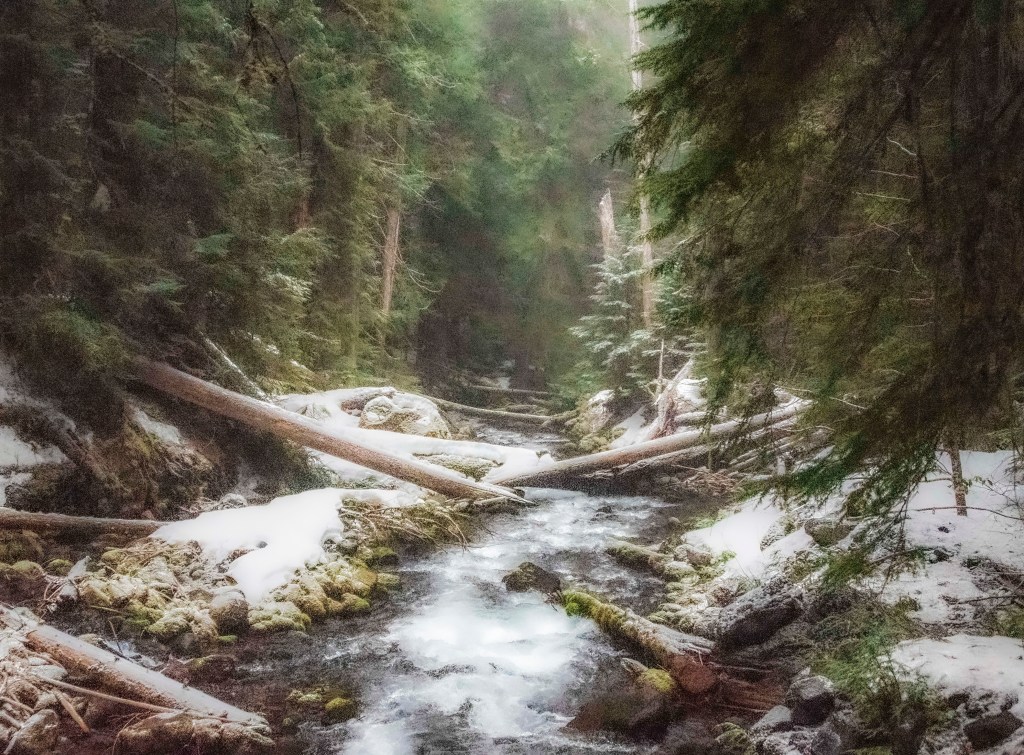
The creek isn’t cruel by not knowing my name, though I’ve known its name my entire life.
On walks, I follow its voice not asking it to know me, for I’m okay being a stranger.
The creek doesn’t need to know my name even during the loneliest times, when snow blankets its banks, when trees block the wind, and when there’s a stillness reaching beyond quiet.
It still sings a melody I’ve memorized.
There are times I wish I could sing like the creek. Perhaps, that’s why I seek its consonance while living downstream, where names are common among a rushing river that is ceaselessin its desire to reach the ocean.
His house is sunshine, a bright glow. The wind can only brush against the windows, slip away into daylight. He warms his hands against its walls and that heat keeps his palms soft. He touches you and you feel it beneath your skin.
Beside his house, there’s a street. Each day cars flood its lanes. Their sound seeps in through cracks and it dims the house slightly. So, he becomes a moon, but doesn’t know the reason he illuminates. He orbits from room to room.
Caused by his gravitational pull, the cars become muffled, a soft gauze of sound, buried, burnt, an unconscious melody of hidden explosions and the rubbing pulse of dark rubber upon packed oil glaze. There’s the slight hum of electric vehicles which strangely is a pedal point. Drone of the world.
Little creatures smile at him, purr if they can. He pets them with hot fingers. But they think he is threadlike, a filament, a passage of current. Slowly, he becomes afraid of moths.
He appears in any room, even rooms the moths never see. They are frantic, as frightened as he. He applies duct tape around the frames of the window screens. They eventually find their way in, erratic, asking questions with a frenzied calmness, is such a thing exists.
When they die, they become powdered dust with wings covered in scales which diffract light. Still, they want lucid explanations about luminosity. His hands clasp, fingers interlace, leaving only the chaos of silence.
Now, the cars can’t be heard, and they attempt to parallel park in awkward positions, their horns mute but they have sign language that comes in the form of lights, voices of the night. The moths are confused, flutter about, discharging dust, as they bump into what they think is an explanation.
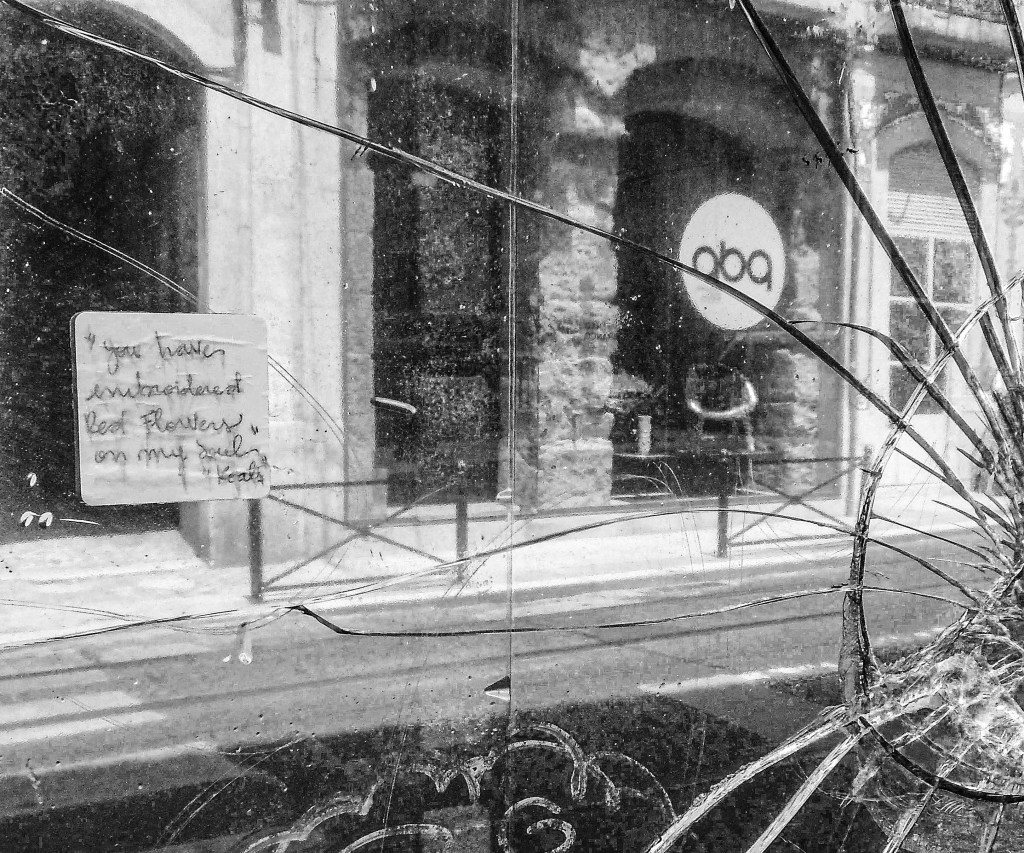
Light Trap, an abstraction. Image taken inside a nearly 100 year old 5 storied parking lot. (click on image to enlarge)
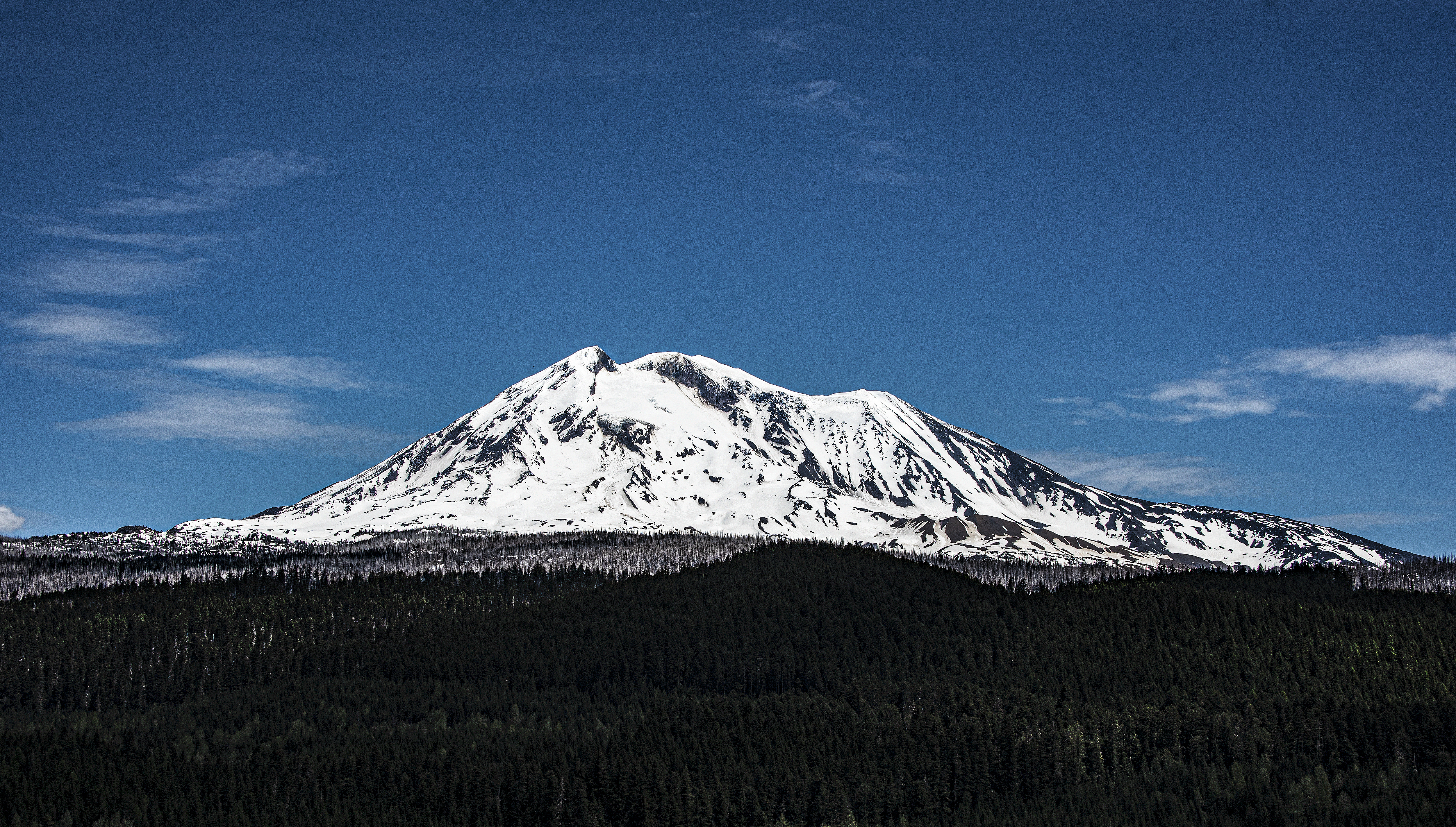
The high lakes are frozen clear, distorting the reflection of the mountain.
Old men with trekking poles stab at hiking trails. All with Homeric hunger pangs, having lost their way back to Paris.
They’re drawn to recite soliloquies to the unmoving cold, to agitated towhees, and dark-eyed juncos.
Each, a glossy eyed Dionysus, drunk on the stinging scent of pine, instilled with a longing to name the mountain Helen.
The mountain? She’s only shy in the rain. They immortalize her with iPhones, wearing a winter skirt. It’s a false offering, but the only real flower in the December forest is an occasional thistle.
Once back upon studded tires and snow chains, their grey hair halos sit like laurel crowns. They profess Socratic love for Helen. But the mountain holds no dialogue, only a mimetic whisper to adorn their computer screens.
This is an image of Mt. Adams I captured in 2020. Click on it to enlarge.